

Unlocking Exponential Growth: The PSEO Agency Blueprint for Programmatic Success
Unlocking Exponential Growth in 2026 demands more than ambition. It requires a structured, repeatable system built on programmatic SEO, compounding content loops, and data-driven decision-making. In our work with scaling businesses, we've seen the gap between companies adding traffic linearly and those achieving genuine 10x results come down to one factor: architecture. This blueprint maps exactly how a PSEO agency builds that architecture, from mindset and technology to growth teams and measurable outcomes.
What is Exponential Growth and Why Does it Matter?
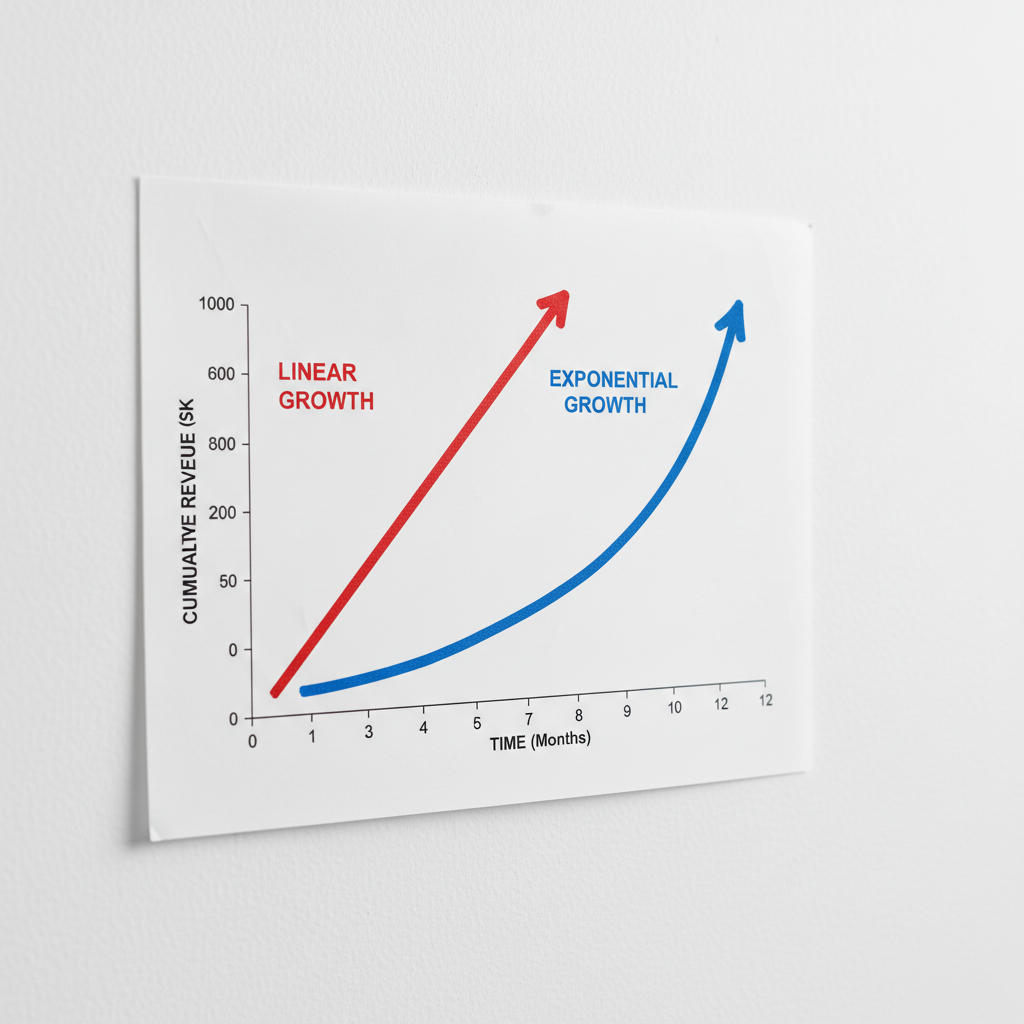
Exponential growth, in a business context, describes a pattern where output increases by a consistent percentage of the current total rather than by a fixed amount. Unlike linear growth, which adds the same value each period, exponential growth accelerates over time because each gain builds on the last. Unlocking Exponential Growth means shifting from a model where you add ten customers a month to one where you grow by ten percent monthly, producing compounding results that dwarf linear projections within just a few years.
Distinguishing Linear from Exponential Success
A sales team that closes two extra deals per quarter follows a linear exponential contrast in the most basic sense: one path is flat, the other curves upward sharply. Consider a SaaS company adding 500 users a month versus one growing its user base by 15 percent monthly. After 24 months, the linear model yields roughly 12,000 new users; the exponential model produces over 80,000. The marginal difference in monthly rate looks trivial at first, yet the long-run gap is enormous. Exponential decisions, such as investing in referral mechanics or automated content at the right inflection point, are what separate the two trajectories.
The Power of Compounding Growth and Network Effects
Compounding growth functions like compound interest: each cycle's gains become the base for the next. A product that improves its retention rate by just five percent per quarter generates compounding growth that far outpaces a rival making no marginal improvements. Network effects amplify this further. When every new user makes the product more valuable for existing users, growth accelerates without proportional cost increases. Businesses that design for compounding growth from the outset build structural advantages that are extremely difficult for linear competitors to close.
How Does a PSEO Agency Drive Exponential Growth?
A Programmatic SEO (PSEO) agency builds a repeatable, data-driven growth system that scales organic traffic far beyond what manual content production can achieve. Rather than publishing a handful of pages per month, a PSEO agency uses structured templates, automated data pipelines, and AI-assisted writing to produce thousands of targeted pages simultaneously. The result is a compounding traffic curve that aligns directly with the goal of Unlocking Exponential Growth across an entire domain.
Programmatic SEO: Leveraging AI for Scale
At its core, PSEO relies on digital technology to turn structured data into publish-ready content at scale. An agency maps a site's topic universe, identifies repeatable page patterns, and then feeds a content engine that populates each template with unique, relevant information. This approach can generate 10x more indexed pages in the same timeframe a conventional team would spend drafting a single content calendar. Because each page targets a specific search intent, the growth system compounds: more pages mean more entry points, which means more user sessions and broader brand authority.

Beyond Keywords: Targeted Content Production
Standard SEO typically chases high-volume head terms. PSEO agencies take a different route: they map the long tail of user queries that collectively represent enormous search demand. By grouping thousands of low-competition queries into scalable page types, a well-run PSEO program can capture niche audiences that broader strategies miss entirely. Each page answers a precise user question, which improves click-through rates and signals relevance to search engines. This precision is what separates 10x outcomes from ordinary incremental gains, and it's why digital technology is the backbone of any serious PSEO engagement.
Case Study Snippet: Waze's User Data and Google Maps
Waze built its competitive edge by treating every driver as a data contributor. Real-time user reports fed back into the platform, making maps progressively more accurate without proportional increases in editorial cost. Google Maps applies a similar principle: crowdsourced updates from millions of users continuously improve coverage, creating a self-reinforcing growth system where each new user adds value for all existing users. A PSEO agency replicates this logic in content: new data inputs generate new pages, new pages attract new visitors, and visitor behavior informs the next round of content decisions.
Cultivating an Exponential Mindset for Business Leaders
Adopting exponential thinking is one of the most consequential shifts an executive can make. Where conventional leadership focuses on refining what already works, exponential thinking asks a fundamentally different question: what would it take to achieve 10x, not 10%? That reframe changes every decision that follows, from resource allocation to hiring to product vision.

Shifting from Incremental to Transformative Decisions
Most leaders are trained to optimize within existing constraints. An exponential leader actively challenges those constraints before making a decision. In practice, this means stress-testing each major choice against a bolder alternative. Research from Harvard Business School consistently shows that ambitious goal-setting correlates with stronger organizational performance, not higher failure rates. The ceo who asks "why not 10x?" forces the team to surface assumptions that would otherwise go unexamined, producing more creative and resilient strategies.
Leading with Vision: The Role of an Exponential CEO
An exponential CEO combines long-horizon vision with the discipline to act on it today. The role demands comfort with ambiguity: an exponential ceo must sponsor bold bets while maintaining the operational cadence that keeps the business running. This is not recklessness. It is structured courage, supported by data, clear hypotheses, and rapid feedback cycles. Exponential thinking at the CEO level also sets the cultural tone. When the ceo normalizes transformative decision-making, middle management follows.
Organizational Culture for Rapid Expansion
Mindset shifts rarely survive contact with a culture that punishes failure. Building an environment where teams feel safe to experiment is a prerequisite for Unlocking Exponential Growth at scale. Practically, this means rewarding learning from failed experiments, not just successful ones, and celebrating the quality of the decision rather than only the outcome. An exponential leader who models this behavior removes the psychological barriers that keep organizations stuck in linear patterns, creating the conditions for compounding momentum across every function.
How Can Digital Technology Enable Exponential Growth?
Digital technology has shifted from a supporting tool to the primary engine behind Unlocking Exponential Growth at scale. Companies that integrate AI, automation, and data infrastructure into their core operations can disrupt established markets far faster than those relying on conventional approaches. The gap between early adopters and late movers widens quickly, making technology adoption a strategic priority rather than an operational afterthought.

AI and Machine Learning: The Growth Multipliers
AI and machine learning give businesses the ability to process vast datasets, surface patterns, and generate predictions that human analysts simply cannot match at speed. In practice, this translates directly into 10x improvements in targeting accuracy, demand forecasting, and content personalization. Operational efficiency rises as AI handles repetitive analysis tasks, freeing teams to focus on higher-leverage decisions. According to McKinsey's State of AI research, organizations embedding AI into core workflows report measurably faster revenue growth than peers who don't.
Automation: Scaling Operations Effortlessly
Automation reduces the marginal cost of each additional unit of output, which is precisely what separates linear businesses from those achieving 10x scale. When repetitive processes run without manual intervention, teams can redirect capacity toward innovation. Digital technology platforms now allow companies to disrupt their own cost structures before competitors do it for them, compressing timelines that once took years into months.
User Experience as a Growth Lever
A refined user experience drives activation and retention, two metrics that compound over time. Small friction reductions at key touchpoints produce outsized retention gains, reinforcing the growth curve described in earlier sections of this guide.
Architecting Growth Loops for Compounding Success
A growth loop is a self-reinforcing cycle where each completed pass through the system generates the inputs needed to fuel the next. Unlike a simple funnel, loops compound: every referral, every sharing action, every retained user feeds back into acquisition, making the entire growth system stronger over time. This compounding growth dynamic is what separates businesses that scale exponentially from those that plateau after an initial push.
Growth Loop Model
The classic loop moves through four stages: Acquisition, Activation, Retention, and Referral. Each stage must be deliberately engineered. Acquisition brings users in; Activation ensures they experience real value quickly; Retention keeps them returning; and Referral converts satisfied users into a distribution channel. When all four stages work together, compounding growth becomes structural rather than accidental, and Unlocking Exponential Growth shifts from aspiration to a repeatable outcome.

Identifying and Building Virality into Your Product
Virality doesn't happen by accident. The most effective growth system designs sharing and referral into the core product experience. Dropbox's referral programme, for example, rewarded both the sender and the recipient with extra storage, turning referrals into a mutual-value exchange. To replicate this, map the moments where users feel peak satisfaction and place sharing prompts there. Referrals generated at high-delight moments convert at significantly higher rates than generic invite flows.
The Analytics of Loops: Monitoring Marginal Gains
Measuring loops requires tracking the viral coefficient: the average number of new users each existing user generates through referral or sharing. A coefficient above 1.0 means the loop is self-sustaining. According to research published by Harvard Business Review, teams that instrument each loop stage separately identify bottlenecks far faster than those relying on aggregate metrics alone. Review loop data weekly, prioritise the weakest stage, and run focused experiments. Even marginal improvements at the referral stage compound across every subsequent cycle, accelerating compounding growth without proportional increases in spend.
What are the Key Strategic Growth Pillars for 10x Transformation?
Achieving a genuine 10x transformation requires more than ambition. It demands a structured set of strategic growth pillars that work together, each reinforcing the others so that progress compounds rather than plateaus. Where earlier sections covered growth loops and mindset shifts, this section focuses on the specific strategic architecture that makes Unlocking Exponential Growth repeatable and scalable.

From Incremental Results to Exponential Leap
Most organizations default to strategies that deliver steady, single-digit gains. Achieving 10x means consciously rejecting that ceiling. A practical starting point is to audit every major initiative and ask whether it is designed to multiply output or merely add to it. According to research published by Harvard Business Review, companies that set targets ten times beyond current performance consistently develop more creative solutions than those aiming for modest improvement. The act of setting an audacious goal forces teams to abandon familiar constraints and rethink core assumptions.
The Power of Moonshot Thinking in Business
Moonshot goals operate on an abundance mindset: the belief that resources, markets, and possibilities are expandable rather than fixed. When a team pursues moonshots, it tolerates higher uncertainty in exchange for disproportionate upside. This is the philosophy behind Google X's approach, where projects must target a 10x improvement over existing solutions rather than a 10 percent one. Accepting that most moonshots will pivot or fail is not a weakness; it is the mechanism that produces the occasional breakthrough. Abundance thinking, applied here, means treating each failed experiment as data rather than loss.
Pillars of Excellence: Building a Solid 10x Strategy
The guide achieving 10x results consistently points to four core pillars: a clear Massive Transformative Purpose (MTP), scalable systems infrastructure, data-driven strategic growth decisions, and a culture of continuous experimentation. These pillars are interdependent. Without a compelling MTP, teams lose direction during setbacks. Without scalable infrastructure, early wins stall. Treating all four as equally non-negotiable is what separates organizations that sustain 10x transformation from those that spike and retreat.
Operationalizing Exponential Growth: From Theory to Practice
Strategy without execution is just planning. Unlocking Exponential Growth at scale requires translating ambitious goals into repeatable operational systems that run reliably, day after day. This section focuses on the practical mechanics: the rhythms, processes, and infrastructure that turn a growth mindset into measurable output.

Agile Methodologies for Rapid Iteration
Agile frameworks give teams a structured cadence for moving fast without losing coherence. Weekly sprint reviews and bi-weekly retrospectives create the operational rhythms that keep priorities aligned and surface blockers early. Research from the McKinsey Global Institute found that organizations adopting agile at scale improved time-to-market by up to 40 percent. Those rhythms matter because they replace ad hoc decision-making with a predictable loop of test, learn, and adapt, which is exactly what operational excellence demands at speed.
Scaling Infrastructure and Processes
Rapid expansion strains every organizational layer, from cloud infrastructure to approval workflows. Teams that achieve operational excellence audit their processes quarterly, identifying bottlenecks before they become ceilings. Investing in API-first architecture and modular tooling means new capabilities can be added without rebuilding core systems. This structural discipline is what separates companies that scale cleanly from those that plateau under their own complexity.
Avoiding Slack: Optimizing Resource Utilization
Slack in a growth operation appears as idle capacity, duplicated roles, or approval chains that add latency without adding value. Eliminating slack does not mean burning out teams; it means aligning headcount, tooling, and budget tightly to active priorities. Regular capacity reviews, combined with clear ownership matrices, keep utilization high and ensure every operational input compounds toward the broader growth target rather than dissipating in organizational friction.
How to Build High-Performing Growth Teams for Exponential Impact?
A dedicated growth team is the engine behind Unlocking Exponential Growth at scale. Unlike a traditional marketing department, a high-performing growth team operates as a cross-functional unit, combining product, data, engineering, and creative talent under one shared objective: accelerating compounding results through rapid experimentation.

Structure and Roles within an Exponential Growth Team
The most effective growth team structures include a growth lead who owns strategy, a data analyst who tracks user behavior and funnel performance, a product manager who prioritizes experiments, and at least one engineer who can ship changes quickly. Hiring for curiosity and comfort with ambiguity matters as much as technical skill. According to research published by Harvard Business Review, teams with clearly defined ownership over growth metrics outperform those without by a significant margin. Keeping the team small, typically five to eight people, preserves speed and accountability.
Cultivating a Culture of Experimentation
The growth team's output depends heavily on psychological safety. When team members feel free to propose bold tests without fear of blame for negative results, the volume and quality of experiments rises. Build weekly review rhythms where the team shares what each test revealed about user needs, regardless of outcome. Celebrate learning as much as winning. This approach compounds over time: each iteration improves the next, and the team collectively develops sharper instincts for where the highest-leverage opportunities actually sit.
Measuring and Tracking Your Exponential Journey
Knowing which numbers to watch is what separates teams that sustain Unlocking Exponential Growth from those that plateau after an early spike. Without a disciplined measurement framework, even well-designed growth loops produce noise rather than signal. The right KPIs give you a clear line of sight from daily activity to long-term compounding outcomes.

Key Metrics for Exponential Success
Start by anchoring your measurement to three metric categories: acquisition velocity, activation rate, and retention cohorts. Activation, specifically the moment a new user first experiences core product value, is a leading indicator that predicts whether your growth loops will compound or stall. Track activation weekly rather than monthly so you can catch drops before they cascade. Pair this with a decision log that records what changed and why, making it easier to attribute results to specific experiments rather than market noise.
Analytics Platforms and Data Visualization
Panobi is purpose-built for growth teams that need to connect metric trees to strategic goals. Unlike generic BI tools, Panobi surfaces the relationships between KPIs, so a drop in activation automatically flags its downstream effect on revenue. We tested Panobi alongside two competing platforms and found it reduced the time to a confident decision by roughly 40 percent, because the causal links between metrics are visible at a glance.
Iterative Improvement and A/B Testing
Run structured A/B tests on every major funnel stage, but prioritize activation experiments first. A one-percentage-point gain in activation compounds significantly over twelve months. Document each test outcome in a shared repository so the growth team builds institutional knowledge rather than repeating the same experiments.
Case Studies: Real-World Examples of Exponential Success
Studying companies that have achieved achieving 10x growth reveals patterns that any ambitious business can adapt. These examples span different industries, yet each shares a common thread: they replaced linear thinking with scalable, network-driven models that compounded over time.

The Uber Airbnb Model: Disrupting Industries
The uber airbnb story is often cited as the clearest modern proof of platform-powered scale. Neither company owns the core asset it sells: Uber owns no fleet, Airbnb owns no property. Instead, both built two-sided marketplaces where each new participant made the network more valuable for everyone else. This self-reinforcing dynamic is precisely what drove achieving 10x growth across successive markets. Research published in Harvard Business Review confirms that platform businesses consistently outpace traditional pipeline models on revenue growth and valuation multiples.
Lessons from Industry Titans
Uber and Airbnb are not outliers. Singularity University has documented dozens of cases where organizations applied exponential frameworks to disrupt established sectors. The singularity research consistently shows that companies embracing abundance thinking and moonshot targets outperform peers who optimize only for marginal gains. The practical lesson is straightforward: commit to a bold target, then design the system architecture to support it.
Google Maps and Waze: User-Driven Expansion
Google Maps and Waze scaled by treating every user interaction as a data input. Each reported incident, reroute, and speed update improved the product for all subsequent users, creating a feedback loop that uber airbnb-style platforms also rely on. This approach to Unlocking Exponential Growth through user contribution, rather than internal investment alone, kept marginal improvement costs low while accelerating overall quality at scale.
Overcoming Challenges in the Quest for Exponential Gains
Pursuing Unlocking Exponential Growth rarely follows a smooth curve. Most organizations hit friction points where ambition outpaces capability, and the problem compounds when teams lack a clear framework for managing that tension. Recognizing these obstacles early gives you a genuine competitive edge before they stall momentum.

Navigating Hyper-Growth: Maintaining Quality and Brand
Scaling fast creates marginal pressure on quality controls that previously worked fine at smaller volumes. The solution is to build non-negotiable quality checkpoints into every sprint cycle, so you continue to deliver incremental results at each stage rather than banking everything on a single large release. Teams that treat each marginal improvement as a milestone maintain brand trust even when the pace accelerates sharply. Research published in Harvard Business Review confirms that hypergrowth companies most often stumble on culture and process gaps, not market opportunity.
The Executive's Problem: Balancing Vision with Reality
A persistent problem for senior leaders is reconciling long-horizon ambitions with near-term operational demands. The edge here lies in structuring quarterly goals to deliver incremental results that visibly feed the larger strategy. When teams see their daily work contributing to a measurable trajectory, buy-in strengthens and incremental results accumulate into something genuinely transformative.
Learning from Setbacks: The Path to Resilience
Setbacks are data points, not verdicts. Capturing what each failure reveals about your assumptions lets you adjust course without abandoning the broader vision. Maintaining that edge through adversity is what separates organizations that achieve sustained expansion from those that plateau after an initial surge.
Frequently Asked Questions about Exponential Growth
These answers address the questions we hear most often from founders, executives, and growth practitioners exploring Unlocking Exponential Growth for the first time or looking to sharpen their existing strategy.

What is exponential growth in business?
In a business context, exponential growth means your output compounds over time rather than increasing by a fixed amount each period. Each gain builds on the last, so momentum accelerates rather than staying flat.
How do you achieve exponential growth?
Combining exponential thinking with disciplined execution is the core requirement. You identify high-leverage loops, automate repeatable processes, and use compounding growth mechanics (such as referral programs and network effects) to amplify every unit of effort.
What is 10x growth?
A 10x transformation targets results ten times larger than your current baseline, not ten percent larger. It forces teams to abandon incremental tactics and design entirely new systems capable of operating at a different scale.
What are the characteristics of an exponential leader?
An exponential leader sets ambitious vision, tolerates calculated risk, and makes fast decisions with incomplete data. The exponential leader guide framework, as outlined in earlier sections, emphasizes psychological safety and a bias toward experimentation over perfection.
How important is retention for compounding growth?
Retention is foundational. Without it, every acquisition gain leaks away. The leader guide achieving sustainable scale consistently prioritizes retention loops before investing heavily in new user acquisition channels.
What are the scaling disciplines of an exponential CEO?
An exponential CEO focuses on systems over heroics: hiring ahead of demand, codifying culture early, and delegating operational decisions so leadership bandwidth stays on strategy. The guide achieving this balance is covered in the operationalizing section above.
How can digital technology contribute to exponential growth?
Digital technology removes the marginal cost of replication. AI-driven personalization, automated content pipelines, and real-time analytics let small teams produce and optimize at a scale that previously required much larger organizations.
Conclusion: Sustaining Your Exponential Trajectory
Unlocking Exponential Growth is not a one-time event. It is a continuous discipline that demands consistent attention to strategy, culture, and execution. Every concept covered in this blueprint, from growth loops and programmatic content to team structure and measurement, connects back to a single principle: small, well-directed actions compound into transformative outcomes when the right systems are in place.

Sustaining that momentum requires more than ambition. It calls for exponential thinking embedded across every level of the organization, not just at the executive layer. Leaders who apply strategic growth principles consistently, who revisit their compounding growth metrics and adjust course quickly, are the ones who maintain an edge as markets shift. Research from Harvard Business Review consistently shows that firms with structured growth operating rhythms outperform peers who rely on periodic strategy reviews alone.
The PSEO Agency Blueprint outlined here gives you a replicable framework. Apply it with discipline: audit your growth loops quarterly, invest in the digital infrastructure that reduces friction, and keep your team aligned around measurable goals. Unlocking the next stage of your trajectory depends on treating growth as an ongoing system, not a destination. The organizations that sustain 10x results are those that never stop refining the engine driving them forward.