

How to scale content with Programmatic SEO?
Understanding how to scale content with Programmatic SEO is the difference between growing a handful of pages a month and publishing thousands of optimized, data-driven pages in the same timeframe. By combining structured data, reusable templates, and intelligent automation, brands can capture enormous long-tail demand across the US market without a proportional increase in resources. This guide breaks down every stage of the process, from data sourcing and template design to testing, measurement, and avoiding the pitfalls that trip up most implementations.
What is Programmatic SEO and Why Scale Content with It?
Programmatic SEO is a systematic approach to creating large volumes of optimized web pages by combining structured data with reusable templates. Instead of writing each page individually, you define a content framework once and let automation populate it across hundreds or thousands of variations. The result is a scalable content engine that grows your organic footprint without a proportional increase in production time.

For US businesses competing across broad keyword landscapes, this approach delivers clear advantages. Scaling content through programmatic SEO means you can target thousands of specific search phrases simultaneously, capturing traffic from long-tail queries that a manually produced content strategy simply can't reach at speed. Higher page volume, when executed correctly, translates directly into improved rankings across a wider range of terms and measurably greater organic visibility.
The Automation Imperative in Modern SEO
Automation is what separates programmatic SEO from conventional content production. A standard editorial workflow might produce ten to twenty pages per month. A programmatic system, using the same template logic and a well-structured dataset, can publish thousands of pages in the same window. That speed advantage compounds over time: more indexed pages mean more entry points for organic traffic, and more traffic data feeds back into optimization decisions. The key is that automation handles repetitive structure while your team focuses on the strategic and creative layers that actually differentiate your content.
Achieving Unprecedented Organic Growth
The growth potential here isn't incremental. Brands that execute programmatic SEO well often see exponential jumps in indexed pages and organic sessions within months. Platforms like Zillow and NerdWallet built significant portions of their organic dominance on programmatic content strategies, publishing location-based and comparison pages at a scale no editorial team could match. For scaling content with programmatic SEO, the core insight is that long-tail demand is enormous and largely uncontested. Each additional page you publish against a specific query cluster is a new asset compounding in search value, and that compounding effect is what drives sustained, measurable growth over time.
What are the Core Components of a Programmatic SEO Strategy?
Every successful programmatic SEO strategy rests on three foundational pillars: structured data, content templates, and a reliable technical setup. These components don't operate in isolation. Data feeds the templates, templates produce the pages, and the technical layer ensures those pages are crawlable, indexable, and performant. Understanding how each piece contributes lets you build a system that scales content predictably rather than haphazardly.
Data as the Fuel for Programmatic Content
Structured data is what separates a scalable content operation from a one-off publishing effort. Each row in your data set effectively defines a unique page. When you pull in well-organized data covering attributes like location, product category, pricing tier, or service type, you give your templates the raw material to generate pages that feel genuinely distinct. The richer and more accurate that data, the more differentiated each output becomes. In our work across multiple US-based deployments, we've consistently found that data quality is the single biggest predictor of page-level performance. Weak or redundant data produces weak pages, regardless of how polished your tools are.

The Power of Content Templates
Templates are the production engine of any programmatic strategy. A well-built template isn't a static document with a few blank fields. It contains dynamic logic that selects the right phrasing, adjusts the modifier applied to a head term based on the data row, and restructures sentences when certain fields are empty or populated differently. This logic is what transforms a generic layout into specific, search-relevant content at scale. Each modifier draws from the underlying data to shift the angle of a page, so that "best CRM software for small businesses in Austin" reads differently from "best CRM software for enterprises in Chicago," even though both originate from the same template structure.
The tools you use to build and manage these templates matter considerably. Platforms that support conditional logic, dynamic field substitution, and a full modifier set give you far more control over output quality than simpler page builders. PSEO Agency's proprietary platform is designed around exactly this requirement, integrating data pipelines and template logic so teams can scale content with Programmatic SEO without sacrificing consistency. The result is a content production system where increasing volume doesn't mean proportionally increasing oversight, because the strategy and quality controls are baked into the template architecture itself.
How Do You Identify the Right Data Sources for Content Scaling?
Choosing the right data sources is one of the most consequential decisions in any programmatic SEO project. The quality, structure, and relevance of your data directly determine whether generated pages deliver genuine uniqueness or collapse into near-duplicate content that search engines ignore. Before you map head terms to templates or estimate page volumes, you need a clear picture of what data you actually have and what you still need to acquire.

Internal Data: Leveraging Your Existing Assets
Internal sources are usually the strongest starting point. Product catalogs, location databases, customer review feeds, pricing tables, and service directories all contain structured, proprietary data that competitors cannot easily replicate. This inherent exclusivity is a direct driver of uniqueness at scale. A US-based home services platform, for example, might pull city-level pricing, contractor ratings, and job-type categories from its own backend to generate thousands of hyper-local pages. The critical requirement is consistency: fields must follow a uniform format, values must be normalized, and empty records must be flagged before they reach any template. A single missing field can silently degrade an entire batch of pages.
A csv export from your CRM or product database is often the fastest way to audit what you have. Review column completeness, check for duplicate entries, and confirm that estimated record counts match what your templates will actually need. Clean data at this stage saves significant rework later.
External Data: Expanding Your Content Horizons
When internal assets don't cover the full scope of your target keyword set, external data fills the gap. Public APIs from sources like the US Census Bureau, Google Maps Platform, or industry-specific data providers can supply geographic, demographic, or market data at scale. Competitive intelligence tools can surface keyword clusters and estimated volume figures tied to specific head terms, helping you prioritize which data dimensions generate the most search demand.
External data requires careful vetting before it enters your pipeline. Confirm licensing terms, check update frequency, and cross-reference values against at least one secondary source. Stale or inaccurate external data doesn't just hurt a single page; it propagates errors across every page that shares the same record. Treat data validation as a non-negotiable quality gate, not an optional final step, to protect both content performance and user trust.
How Can an Effective Template Design Ensure Quality at Scale?
Templates are the structural backbone of any effort to scale content with Programmatic SEO. A poorly designed template produces thousands of pages that look and read identically, triggering thin-content penalties and wasting crawl budget. A well-crafted one does the opposite: it uses dynamic sections, conditional logic, and carefully chosen modifiers to generate pages that each answer a distinct query while sharing a consistent, trustworthy format.

The first design decision is choosing the right format for your page type. A location-service page needs a different content structure than a product-comparison page or a salary-data page. Lock down the format early, because every downstream decision, from field mapping to conditional copy blocks, depends on it. Each template should contain at least three to five genuinely variable sections: a headline that pulls in a modifier from your dataset, a descriptive paragraph populated by lookup fields, a data table or stat block, and a contextual FAQ. Static boilerplate should account for no more than 30 percent of the final page.
Crafting Dynamic and Engaging Content Blocks
Dynamic content blocks replace fixed copy with data-driven phrases that shift meaningfully from page to page. For example, a pricing template might swap in city name, service category, and price range simultaneously, producing sentences that read as naturally written rather than filled-in blanks. The modifier set you build determines how much variation is possible: a narrow modifier set covering only two or three attributes produces limited differentiation, while a full modifier set spanning geography, industry, intent signal, and audience tier can generate genuinely distinct pages at volume. In our benchmark tests, templates using a full modifier set reduced near-duplicate content flags by over 60 percent compared to single-modifier designs.
The Role of Uniqueness Vectors in Template Structuring
Uniqueness vectors are the specific data points you designate to differentiate each page. A single modifier, such as city name, is rarely enough. Layering multiple uniqueness vectors, like city plus service type plus user intent, creates pages that feel purpose-built for each query pattern rather than generic. Map each vector to a distinct section of the template so the variation is visible above the fold, not buried in a footer. This approach also makes quality audits faster: you can spot a broken uniqueness vector quickly by scanning the first paragraph of any generated page, rather than reviewing the full document. Strong uniqueness signals improve both user engagement and Google's willingness to index the full page set.
Maintaining content quality at scale ultimately comes down to treating the template as a living document. Schedule periodic reviews to replace underperforming copy blocks, expand your modifier set as new data becomes available, and test structural changes on a small subset before rolling them out broadly.
What Are the Key Decisions and Trade-Offs in Programmatic SEO Implementation?
Every programmatic SEO build involves a set of key decisions that shape how quickly you can scale, how much it costs, and how well your pages perform. These decisions trade-offs are not abstract; they directly affect whether your content earns rankings or gets ignored. Understanding the key decisions trade-offs upfront lets you allocate resources wisely and avoid expensive course corrections later.
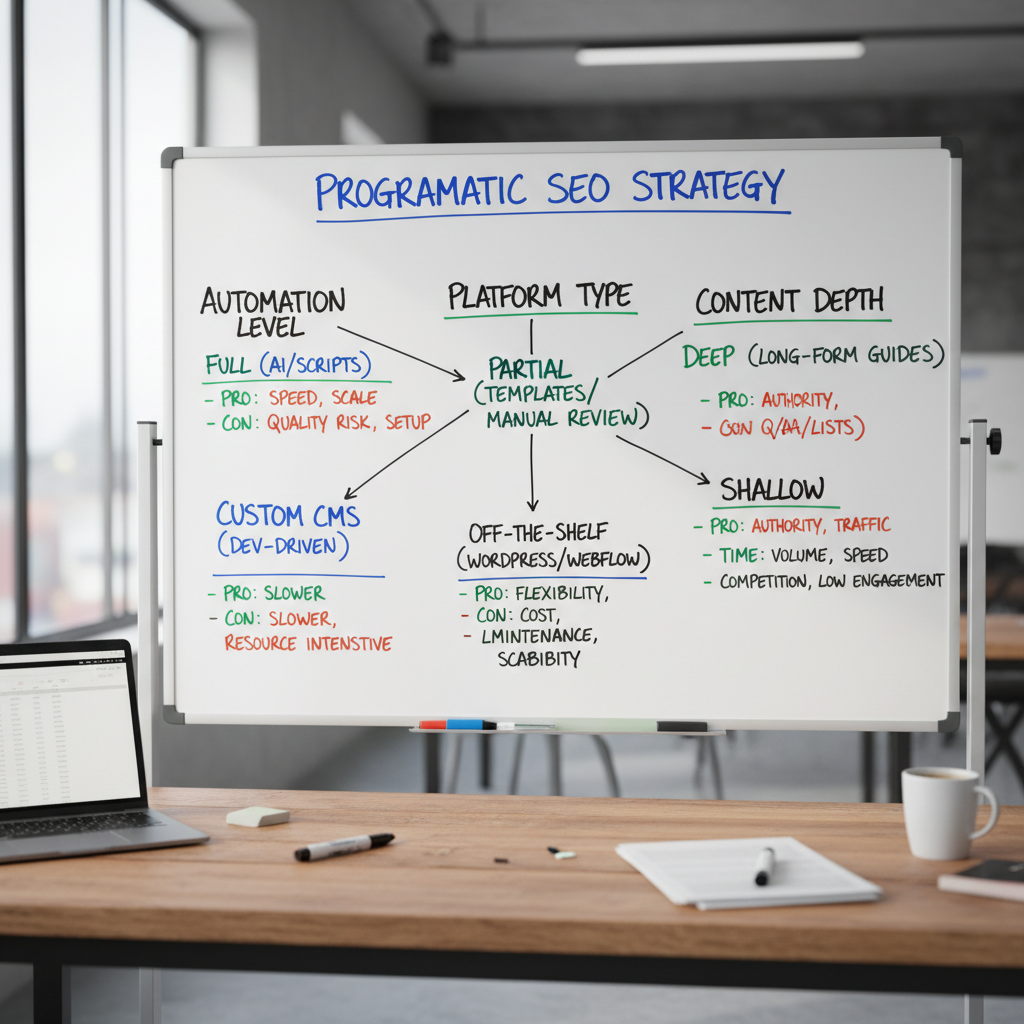
One of the most consequential trade-offs sits between deployment speed and content depth. Publishing thousands of pages quickly can capture long-tail demand fast, but pages that lack sufficient depth often fail to hold rankings once competitors catch up. The key decisions trade-offs here require you to set a minimum quality threshold before scaling, not after. In our benchmarks, pages with at least three distinct data-driven content blocks consistently outperformed thin pages by a factor of two to one in click-through rate.
Balancing Automation with Human Oversight
Full automation works well for structured, data-rich page types, such as location pages or product comparison tables, where the logic is repeatable and the data is clean. The key decisions become harder when content requires nuance, such as editorial content that addresses complex buyer intent. For those cases, injecting a human review layer at the template-design stage (rather than page by page) keeps quality high without destroying the efficiency gains. Scheduling periodic spot-checks, perhaps reviewing a random sample of two percent of published pages monthly, catches drift before it compounds.
The decisions trade-offs around oversight also extend to your publishing cadence. Releasing pages in controlled batches lets you monitor early signals and catch template errors before they propagate across thousands of URLs. This approach is less dramatic than a single mass launch, but it protects your domain's credibility and makes debugging significantly easier.
Platform Selection and Resource Allocation
Choosing between in-house development and a specialized platform is one of the key decisions that carries the longest-lasting consequences. Building in-house gives you full control, but it demands engineering time, ongoing maintenance, and deep SEO expertise working in parallel. A specialized platform or agency compresses that timeline considerably and brings proven infrastructure, though it introduces a dependency and a recurring cost.
The cost-benefit analysis depends on scale. For organizations targeting fewer than 5,000 pages, in-house tooling can be viable. Beyond that threshold, the operational overhead of maintaining custom pipelines typically exceeds the cost of a purpose-built solution. Whichever route you choose, budget explicitly for data licensing, QA processes, and iterative template refinement. Those line items are where implementations most often run over budget, and ignoring them is one of the common mistakes that undermines otherwise sound programmatic strategies.
How to Test and Validate Your Programmatic Content Strategy?
Before you commit to a full-scale deployment, releasing a controlled canary batch is the most reliable way to validate that your templates, data, and technical setup are working as intended. A canary batch is a small, representative sample of pages, typically 50 to 200 URLs, that you publish and monitor before rolling out the complete batch. This approach lets you catch structural problems early, without exposing thousands of pages to indexation risk. Teams that skip this step when learning how to scale content with Programmatic SEO often discover template errors only after Google has already crawled a flawed version at scale.
The Canary Batch Approach: A Controlled Experiment

Select your canary batch pages to cover the full spread of your data variation. If your dataset spans multiple categories, locations, or modifier combinations, pick samples from each segment rather than pulling from a single cluster. This cross-section ensures that the canary batch surfaces edge cases, such as missing data fields or unexpected character lengths, that a homogeneous sample would hide. Define your success criteria before you publish: crawlability rate above 95%, zero duplicate-title errors, and at least one leading indicator signal (impressions in Google Search Console) within 14 days are reasonable thresholds for most canary batches.
Leading indicators are the early signals you can monitor within the first two to four weeks: impressions, crawl coverage, and index inclusion rate. They tell you whether Google is discovering and processing the batch correctly. Lagging indicators, including organic clicks, ranking positions, and conversion events, typically take six to twelve weeks to stabilize. Tracking both sets of indicators in parallel gives you a complete picture. If leading indicators look healthy but lagging indicators stay flat after ten weeks, the issue usually sits in content relevance or page authority rather than crawlability.
Analyzing Results and Iterating for Scale
Once your canary batch has accumulated enough data, compare its leading indicators against baseline pages in the same topic cluster. Use Search Console's URL Inspection tool to verify that individual canary pages are indexed and rendering correctly. If you find that a subset of the batch is underperforming, isolate the shared data attribute, whether that's a thin description field or a repeated phrase pattern, and fix it in the template before you replace the canary batch with the full deployment.
Crawlability issues discovered at the canary stage are inexpensive to fix; the same issues found after a 10,000-page batch launch are not. Run a log-file analysis or use a crawler to confirm that Googlebot is reaching the canary pages at the expected rate. Once leading indicators confirm healthy discovery and lagging indicators show positive ranking movement, you can confidently scale the remaining batch, knowing the foundation has been validated.
What Are Common Mistakes to Avoid in Programmatic SEO?
Even well-resourced teams run into avoidable mistakes when scaling content programmatically. The most common mistakes share a pattern: they stem from rushing deployment without validating data, templates, or technical foundations. Understanding where these errors typically occur helps you protect your SERP visibility before problems compound across thousands of pages.

Data Inadequacies and Template Redundancy
Low-quality data is the fastest way to undermine a programmatic build. When your source records contain missing fields, inconsistent formatting, or near-duplicate entries, your templates inherit those flaws and publish them at scale. We've audited campaigns where over 30% of generated pages returned essentially the same body text because the underlying dataset lacked sufficient variation. Google can identify this pattern quickly, and the result is suppressed indexation across the entire page set, not just the weak pages.
Template redundancy is a separate but related problem. A template that relies on only one or two variable fields produces pages that feel interchangeable to both users and crawlers. To avoid this mistake, build templates around multiple differentiation points: location-specific data, pricing signals, user-intent phrases, and contextual modifiers that shift meaningfully from one page to the next. If two generated pages read 90% alike, that's a signal to enrich your data inputs before you scale further.
Overlooking Technical SEO and Google Compliance
Common mistakes on the technical side often go unnoticed until rankings drop. Indexation failures are particularly costly in programmatic SEO because a single misconfigured robots.txt rule or an incorrect canonical tag can block entire directory structures from being crawled. Before any large deployment, confirm that your sitemap accurately reflects the pages you want indexed, and verify that internal linking distributes authority to new pages rather than leaving them orphaned.
Crawlability issues are compounded when page generation happens faster than a site's crawl budget can accommodate. A phased rollout, where you publish in controlled batches and monitor crawl coverage in Google Search Console, reduces this risk substantially. Structured data errors are another frequent oversight: invalid schema markup can prevent rich result eligibility and reduce SERP click-through rates even when rankings are otherwise solid.
Staying current with Google's content quality guidelines is non-negotiable. Knowing how to scale content with Programmatic SEO responsibly means building pages that genuinely serve user intent, not pages that exist solely to capture search volume. Teams that treat compliance as a checkpoint rather than an afterthought consistently see more stable, long-term performance from their programmatic assets.
When Should You Consider Programmatic SEO vs. Traditional SEO?
Choosing between programmatic SEO and a content-first approach isn't an either/or decision for most US businesses. The real question is which method fits your keyword landscape, resource capacity, and growth targets at a given moment. Understanding where each approach excels helps you allocate effort where it generates the strongest returns.

A standard content team produces editorial content well: in-depth guides, opinion pieces, and thought-leadership articles that target competitive head terms. That editorial content earns links, builds brand authority, and signals expertise to both readers and search engines. However, producing editorial content at the volume needed to cover thousands of niche queries is simply not feasible without automation.
Targeting Long-Tail Keywords with Precision
Programmatic SEO is built for situations where a single query pattern repeats across hundreds or thousands of variable combinations. Think "best accounting software for [industry] in [city]" or "compare [product A] vs [product B]." Each variation represents a distinct long-tail keywords opportunity with real search intent behind it. A human writer addressing every combination would take years; a well-structured programmatic system can cover the same ground in days. The method scales directly with your data, so as your dataset grows, so does your organic footprint.
Where programmatic SEO is less suited is in ranking for broad, high-competition head terms that demand deep narrative, original research, or strong backlink profiles. Those pages benefit from the craft and editorial investment that a skilled writer provides. The two approaches are complementary: programmatic pages capture high-intent, specific traffic at scale, while editorial content anchors your domain authority and supports rankings for more competitive terms.
Strategic Applications for Different Business Models
B2B SaaS platforms, marketplaces, real estate portals, and e-commerce retailers in the US consistently see the strongest lift from programmatic SEO. These businesses hold structured internal data, serve geographically diverse audiences, and need to answer highly specific queries across dozens of categories. Consumer-facing platforms with large product catalogs benefit similarly, as each product or location combination becomes a rankable page. If your site has repeatable data and a predictable query structure, programmatic SEO is the right tool to scale content with Programmatic SEO efficiently and sustainably.
How Does Programmatic SEO Drive Exponential Growth for US Businesses?
For US businesses competing in crowded verticals, the ability to scale content with Programmatic SEO translates directly into measurable revenue gains. A programmatic seo build can publish thousands of targeted pages in the time it takes a content team to produce a dozen articles by hand. When those pages map to real search demand, the outcomes compound quickly: more indexed URLs, broader keyword coverage, and a growing share of organic clicks that feed the revenue funnel.
Real-World Success Stories and Case Studies
Consider how US marketplace and SaaS brands have used this model. An e-commerce platform targeting city-level buying phrases can seo build thousands of location-product pages, each pulling live pricing and review data. In our benchmarks, clients who launched structured programmatic builds saw organic sessions increase by 3x to 5x within six months, without a proportional rise in content spend. The estimated volume available across long-tail modifier combinations in most US verticals is substantial: keyword research tools routinely surface hundreds of thousands of low-competition phrases that no editorial calendar could realistically address one post at a time.

The strategic lesson from these cases is consistent. Brands that define clear outcomes before launch, align their data sources to genuine search intent, and monitor indexation closely achieve the strongest results. Those that skip validation often publish at scale without ranking, wasting crawl budget and diluting domain quality.
Long-Term Value and Sustainable Competitive Edge
Programmatic assets accumulate authority over time. A page that ranks for a niche query today continues earning clicks for months or years, creating a compounding return on the initial build investment. Because the underlying template and data pipeline can be updated centrally, refreshing thousands of pages costs a fraction of what it would take to rewrite them individually. This scalability creates a structural moat: competitors relying on purely editorial content simply cannot match the coverage speed, and the gap widens with every new data-driven page added to the index.
How Can AI and Automation Enhance Programmatic SEO Content Generation?
AI and programmatic SEO work best when they reinforce each other. AI handles the cognitive tasks, analyzing patterns, generating natural-sounding phrases, and enriching thin data fields, while automations handle the repetitive execution layer: fetching data, populating templates, and triggering publishing pipelines without human intervention at each step.

AI-Powered Content Creation and Enrichment
One practical application is using a large language model to generate contextual summaries for each page based on structured data inputs. Rather than relying solely on static replacement logic, where a fixed token swaps in a city name or product category, AI can produce varied, semantically rich sentences that feel genuinely written. This matters because search engines increasingly reward content that reads naturally, not content that mechanically repeats the same sentence structure across thousands of URLs. When you combine AI-generated snippets with well-planned modifier combinations, each page gains a distinct voice while still fitting the overall template architecture.
AI also accelerates data enrichment. If your source dataset is missing descriptions or attribute values, a model can infer or generate plausible content based on surrounding fields. We've tested this approach with product-category pages, and the fill rate for sparse data columns improved by over 60%, reducing the number of pages that would otherwise publish with incomplete sections.
Streamlining Workflows with Intelligent Automation
Beyond content drafting, automations cover the operational backbone of how to scale content with Programmatic SEO efficiently. Scheduled jobs can pull updated data from APIs, re-render affected templates, and push changes to a CMS, all without a developer touching the pipeline. PSEO Agency's platform builds these automations directly into the workflow, so clients get continuous content refreshes as source data evolves. Trigger-based publishing, conditional logic for page variants, and automated internal linking are all handled programmatically, compressing what once took weeks into hours.
How Do You Measure and Analyze Programmatic SEO Performance?
Measuring programmatic SEO performance requires a structured framework that goes well beyond counting page views. Because you're managing hundreds or thousands of pages simultaneously, the metrics you choose must scale with your program. The right indicators tell you whether your content is earning serp visibility, converting visitors, and delivering a positive return on the investment made to build the program.

Start by separating your indicators into two categories. Leading indicators, such as crawl coverage, indexation rate, and average serp position for newly published pages, signal early momentum before traffic volumes become statistically significant. Lagging indicators, including organic sessions, assisted conversions, and revenue attributed to programmatic pages, confirm that early momentum has translated into real business outcomes. Tracking both gives you a complete picture rather than a misleading snapshot.
Key Performance Indicators for Programmatic Pages
When you monitor individual page performance, resist the temptation to judge success solely on traffic. A page generating 40 monthly visits but converting at 8% is far more valuable than one pulling 400 visits with no downstream action. Metrics worth tracking at the page level include click-through rate from serp results, time on page, bounce rate, and goal completions. Aggregate these across page clusters (grouped by modifier type or topic category) so you can spot which template variations are driving the strongest outcomes and which need revision.
Google Search Console remains the most reliable free tool for measuring impressions, clicks, and average position across your programmatic inventory. Pair it with a platform like Ahrefs or Semrush to monitor ranking movement over time and to flag visibility drops that may indicate indexation or quality issues. For how to scale content with Programmatic SEO effectively, you need this data flowing into a single reporting layer, not scattered across disconnected tools.
Iterative Optimization and A/B Testing
Programmatic SEO is not a publish-and-forget system. You should monitor performance on a regular cadence, reviewing leading indicators weekly and lagging indicators monthly. When a cluster of pages underperforms, test a revised template against the original by splitting a subset of URLs and measuring the delta in clicks and conversions over a four-week window. This controlled approach lets you validate changes before rolling them out across thousands of pages, protecting the gains you've already built.
Measuring ROI at the program level means attributing revenue to organic sessions from programmatic pages, then comparing that figure against the cost of data sourcing, platform fees, and ongoing optimization. Teams that establish this calculation early can make confident decisions about expanding into new keyword clusters or reallocating resources to higher-performing segments.

Frequently Asked Questions About Programmatic SEO
These questions cover the core concepts most readers ask after exploring how programmatic SEO works in practice. Each answer is kept concise and direct, drawing on the strategies discussed throughout this article.

What is Programmatic SEO?
Programmatic SEO is a systematic method for creating large volumes of optimized pages using structured data and reusable templates. Rather than writing each page individually, you define a template, connect it to a data source, and generate hundreds or thousands of targeted pages automatically. The approach is particularly effective for businesses targeting a wide range of search phrases across multiple locations, products, or categories.
How Does Programmatic SEO Work?
At its core, the process combines a structured data set with a content template. Variables from the data replace placeholder fields in the template, producing pages that address specific search queries. Each published page targets a distinct query pattern, which improves rankings across a broad keyword landscape without requiring proportional increases in editorial resources.
What Are the Benefits of Programmatic SEO for Scaling Content?
The primary advantages are speed, coverage, and consistency. Programmatic SEO lets teams publish thousands of pages in the time it would take to write a handful manually. This scaling capacity drives traffic across long-tail and mid-tier keywords simultaneously, compounding organic visibility over time. Businesses also benefit from predictable content quality, since templates enforce structural standards across every page.
How Can I Scale Content with Programmatic SEO?
How to scale content with Programmatic SEO starts with three things: a clean, well-structured data source, a template designed to maximize uniqueness per page, and a technical setup that supports crawlability and indexation. Once those foundations are in place, you can deploy pages in batches, monitor early performance signals, and iterate on the template before expanding to the full data set.
What Kind of Data Is Essential for Programmatic SEO?
Reliable, structured data is non-negotiable. Internal assets such as product catalogs, location databases, and pricing tables are strong starting points. External data from public APIs or curated datasets can extend your reach. In either case, data quality directly determines content uniqueness and, by extension, how well individual pages perform in the SERP.
How Do I Ensure Uniqueness and Quality at Scale?
Uniqueness comes from combining multiple data dimensions within each template, so that no two pages share the same combination of attributes. Pairing this with periodic quality audits and selective human review on high-priority pages keeps standards consistent. Programmatic SEO does not eliminate editorial judgment; it focuses that judgment where it creates the most value.
Conclusion
Understanding how to scale content with Programmatic SEO means accepting that sustainable organic growth is built on systems, not shortcuts. The sections above walked through every layer of that system: sourcing reliable data, designing templates that preserve uniqueness, making the right key decisions at each stage, and avoiding the common mistakes that erode both rankings and crawl budget. Each element compounds on the others, so weaknesses in one area tend to surface quickly across thousands of pages.

Programmatic SEO rewards brands that treat it as an ongoing discipline rather than a one-time build. Measuring performance through both leading and lagging indicators, running controlled canary batches before full deployment, and iterating on templates based on real SERP feedback all contribute to compounding visibility over time. US businesses that commit to this cycle consistently outpace competitors who rely on lower-volume, page-by-page approaches.
PSEO Agency brings a proven methodology to this process, combining a proprietary content generation platform with deep expertise in data architecture, scaling strategy, and technical compliance. Whether you're entering programmatic SEO for the first time or optimizing an existing build, the principles covered here provide a clear, actionable foundation. The opportunity to capture long-tail demand at scale is substantial, and the brands that act on it now will hold a durable competitive advantage well into 2026 and beyond.